This
is very good! But I don't want to be so arrogant as to say that even
as scientist I have never fallen into any of these traps ... I can only
say that I always try not to, and I welcome being called on it if I do!
Italy was viewed for a while as an example NOT to follow... quite the contrary! Yes, I’m biased, as that’s my native country, but the facts of Italy’s behavior, both at the level of government and people, during this pandemic cannot be denied. This article explains very well what has been happening as Italy is starting its own (deliberately slow) path to opening up. As Italians move toward a less stringent regimen to minimize their exposure to the coronavirus, they can take pride in an unusual collective effort. nytimes.com Opinion | How Italy Coped, and Will Keep Coping As Italians move toward a less stringent regimen to minimize their… As Italians move toward a less stringent regimen to minimize their exposure to the coronavirus, they can take pride in an unusual collective effort.
I continue to be baffled by the desire of so many to downplay the death toll of this virus. Why is this happening? I really hate to think that many are ready to trade-off life for economic recovery, as if this were really a dichotomy. I'm not the only one who thinks that economic recovery will start only when people will feel safe. People will not feel safe as long as they don't know who is contagious, and are assured that the medical system can take care of them, with adequ ate availability and, as soon as possible, effective therapies (while we wait for the vaccine). The upshot is that prioritizing safety by opening up slowly and making sure that we don't cause new waves, is ALSO the best path to recovery. Let me stress again that we DO have to start allowing people to get out of their houses to go back to work. Clearly we cannot stay home forever.... Even that does not make the virus "go away" . It's still out there waiting for us to come out...
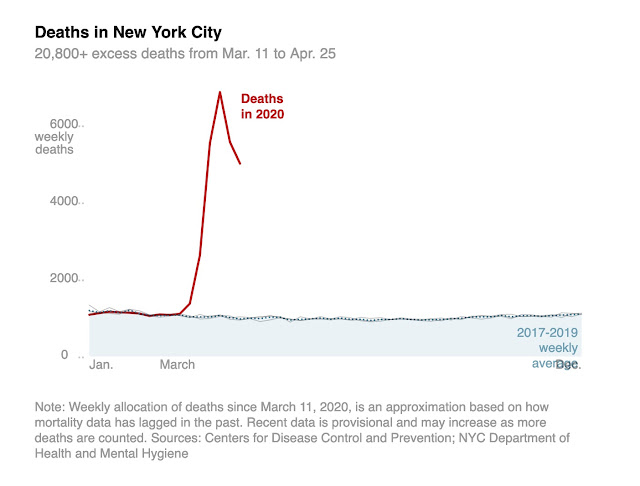
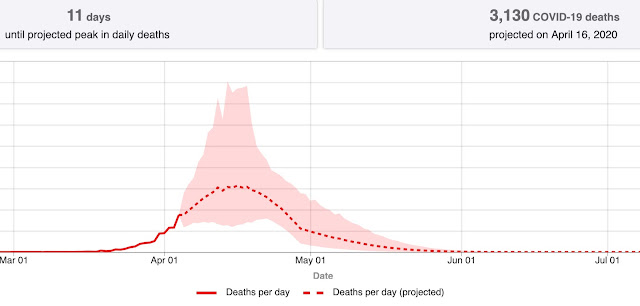
I am not surprised that folks are confused about the apparent contradiction between "light at the end of the tunnel" and "the worst weeks are still to come", and even Dr. Fauci (with all due respect) did not do a good job explaining that... This goes together with them talking alternatively about "peaks" and about "flattening the curve". The explanation will be totally obvious to folks who have had calculus... but I will assume that that knowledge might be rusty for many at this point. What's been unclear (IMO) is that they have been talking about two different curves, and they have not bothered to explain that fact. The first curve (first picture) shows the daily number of deaths in the US. I have been showing the daily number of new cases. The shape is the same. So, what happens is that deaths (or new cases) keep increasing as the virus takes off. If measures are effective the daily number of new cases (and, later, deaths)...


Comments
Post a Comment